It took me a long time to figure out what data I might visualize for this exercise. Lots of things came to mind, most of which felt like I needed to be very involved and present in data collection. Given the week I was having, I knew that was going to be hard. I contemplated collecting data on how many glasses of water I drink in a day, but then I realized it wouldn’t be “interesting” enough — or rather I wouldn’t have enough data for it to be an interesting visual (though good for me since I have been quite dehydrated!). I think this goes back to the point Craig made about the impression of data being boring, and how that impacts what we might collect or visualize.
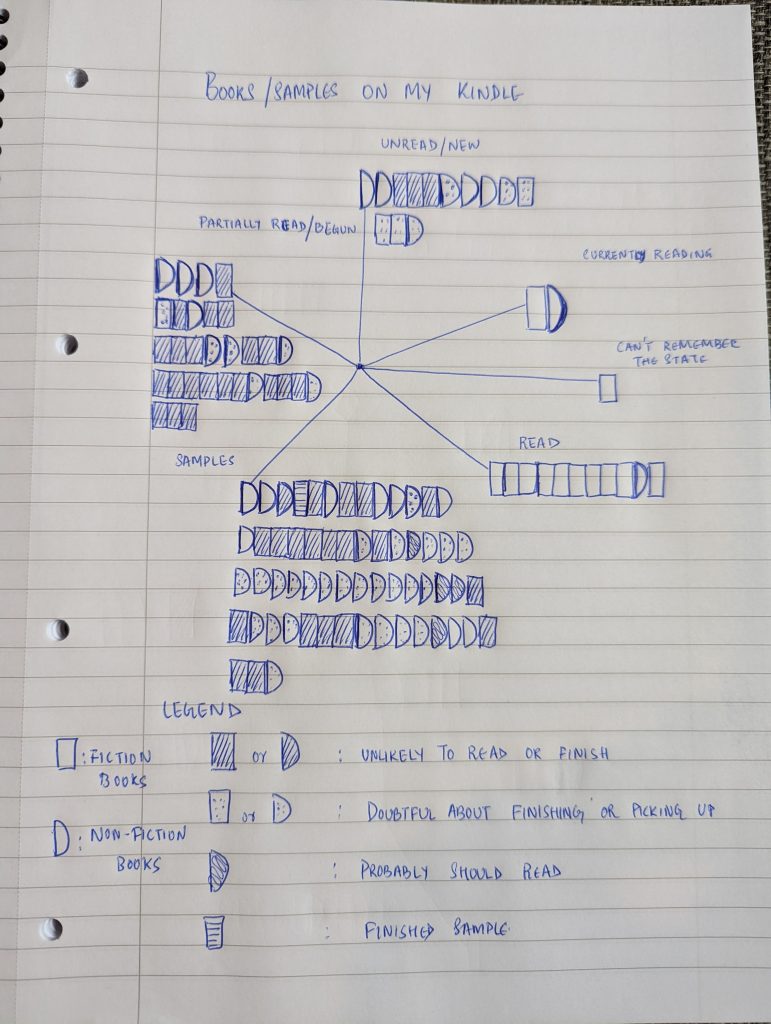
I decided to create a visual of the items on my kindle from this year. One of the main reasons I chose this was because the data was already there and all I needed was to visualize it. On the other hand, I really did not want to visualize it because I knew what I would find and I did not want to see it (dozens over dozens of samples, and hardly any fully read books). Further, I could find myself doing what Carlos mentioned where I was trying to present a “good” picture. I think I could have afforded to mark a few more books as those I will never finish, or get to. I think that is a combination of wishful thinking and me wanting to appear in a better light, where “better” is defined as having the intent to start and finish a book. I also found that I was judging myself with data related to fiction versus non fiction — where I could see myself desiring to see a better outcome related to non-fiction related reading (I have a PhD student image to keep up with!). All in all, I wasn’t surprised with what the visual showed, though it is interesting to note all the emotional baggage that comes with this data I have collected. If these were library books I started and returned, I wouldn’t have this telling set of items I look at everyday to remind me how I’ve somehow failed to meet some hypothetical ideal. Even though the library book data is also something I could potentially collect and visualize, it isn’t actively on a device I look at and interact with everyday.
2 responses to “Data Visualization – The items on my kindle”
This is great Meenakshi, there are so many interesting strands to your reflection. I think it’s revealing that the data makes you feel that you’ve somehow not measured up to “some hypothetical ideal”. Does that motivate you or work against you?
I’m also drawn to your comment about “all the emotional baggage that comes with this data I have collected” because data are normally presented as objective and impartial. Would you have the same feelings if you were thinking about what to capture and represent about others?
In thinking about your first question Cathy — does the data motivate me or work against me — it seems that it does both. In that, looking at the visualization itself, I realize I’ve not been doing as “bad” a job as I thought (and urges me to keep doing what I’m doing), but the daily experience of the same data for me where I scroll through dozens of samples and unread books to get to what I need to read makes me feel quite demotivated.
You bring up such an interesting point to related to the nature of data. I’ve never thought of data having an emotional component, particularly when thinking about data on others. How could it? But if I feel that it does, when it’s my own data, no doubt others do as well. Is the nature of the data determined by the collector when it is collected, or by the user who experiences it? You’ve given me a lot to think about!