
Two of the major themes explored in this block that stood out to me include the datification of education as well as the presentation of ‘personalised learning’.
The ‘datafication of education’ refers to the ways in which intensive data processing is increasingly pervading and reshaping formal educational activities (Knox, Williamson & Bayne 2019) Knox, Williamson and Bayne argue that the datafication of education has been largely influenced by Biesta’s concept of ‘Learnification’ which places students or ‘learners’ at the forefront of these educational activities.
Many data driven technologies have emerged in recent years that utilise information harvested from students or ‘learners’ to provide ‘personalised’ learning experiences in an attempt to confront the challenges presented by the diversity of individual preferences and the unique complexity of each human brain (Friesen, 2020, p.142)
Personalised Learning systems take various forms that can be categorized in to either ‘responsive’ or adaptive learning systems.
The level of ‘personalisation’ present in responsive systems can be as simple as allowing students to edit their profiles (Avatars, colour themes etc.) while more sophisticated responsive systems are data driven and can recommend learning materials appropriate to students level of proficiency through data collected from them. Some of the more advanced ‘responsive’ systems build on this data driven technology by using machine learning to adapt to students learning needs in real time. (Bulger, M. 2016. P. 6)
One of the major issues that appears with the use of personalised learning systems is that a focus on data can lead to a ‘laser focus’ on numbers and other performance metrics that are quantifiable but fail to take in to account the whole learning process and social interactions that go along with it. (Bulger, M. 2016. P. 13). The social skills that students develop through classroom activities such as communication, collaborative skills, teamwork and relativity with ones peers in a particular learning environment are not at present tracked through personalised learning systems.
The future of some personalized systems in development from IBM (Watson) and Carnegie Learning (Cognitive tutor) appears to take the form of an ‘intelligent tutor’ that aims to replicate human interaction by communicating conversationally and using facial recognition technologies to respond to human emotions displayed by the student.
However, support for personalized or data driven learning systems is often grounded in intuitive or anecdotal enthusiasms without a grounding in empirical evidence. (Bulger, M. 2016. P. 14)
The idea of an intelligent tutor reminded me of a previous reading from the IDEL course last semester Where a student who had been having a conversation with a ‘teacherbot’ concluded that while they did not feel like they had learned anything, they had been prompted to think – and “Isn’t this what every good teacher/trainer strives for?” , (Bayne S. (2015) p. 463). This view of learning and thinking being symbiotic underpins my own approach to and philosophy of teaching and is a key feature of Mike Hughes ‘Magenta Principles’ that has been very influential in recent years in the field of secondary education pedagogy “learning is the consequence of thinking… therefore our job is to get them to think” (Hughes, 2014)
In Friesen’s article, ‘dialogue’ is critiqued as the idealist view of learning personalization taking the form of one to one personal tutoring akin to something like Socrates and Plato, Plato and Aristotle, and Aristotle and Alexander the Great resonated with me as a teacher of History and Classics. I began to reflect on all of the personal interactions I have with my own students through questioning (The so called ‘Socratic method’) – some of which would be quantifiable in data while others would probably not be so easy to ‘Data-fy’.
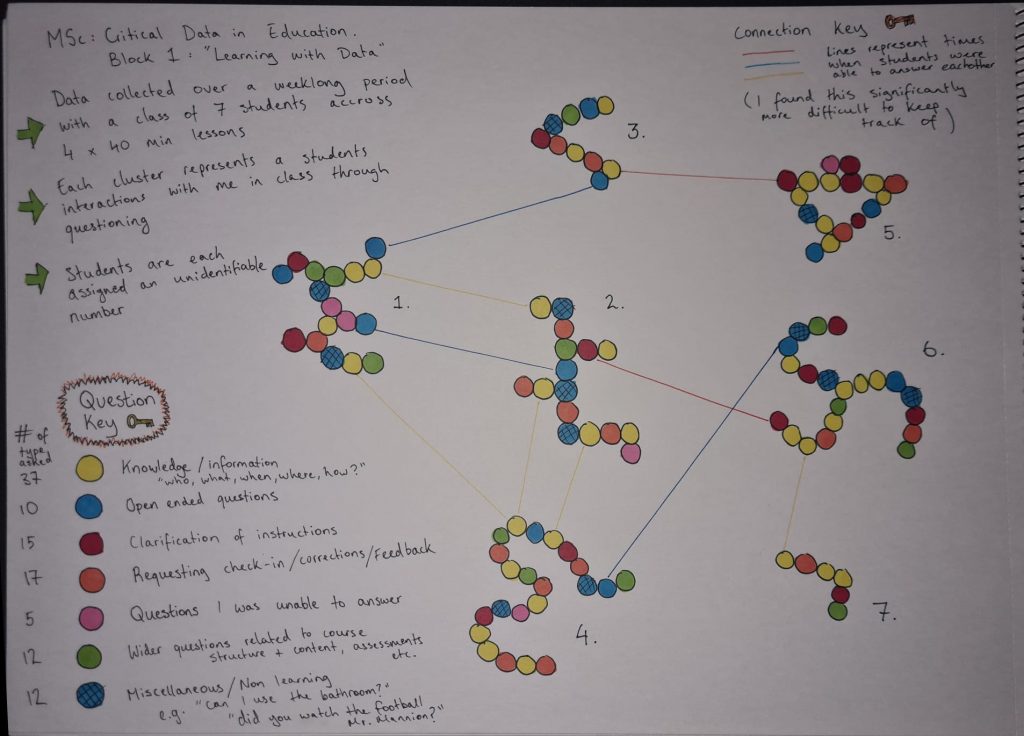
Learning analytics should leverage rather than replace human contact (Tsai, Perotta and Gasovic, 2019) – Therefore I made the human connection between teacher and students the focus of my visualisation
Research shows that teachers can ask up to 400 questions per day and as many as 120 questions per hour (Levin & Long, 1981). I figured this may make the data difficult to record and so I decided to instead focus my data collection on the questions that the students of one of my smaller classes posed to me over a single week (four 40 minute lessons) This made the data easier to collect and also would better model how some learning personalization technologies function via recording of student’s (learner’s) data rather than the teacher.
It proved to be a more challenging data collection than I thought! I began by ad hoc categorising the types of questions a particular group of students asked me throughout the course of a week’s lessons on a sheet of paper in class and keeping a tally sheet for each student and making a tick beside each category when they asked me something.
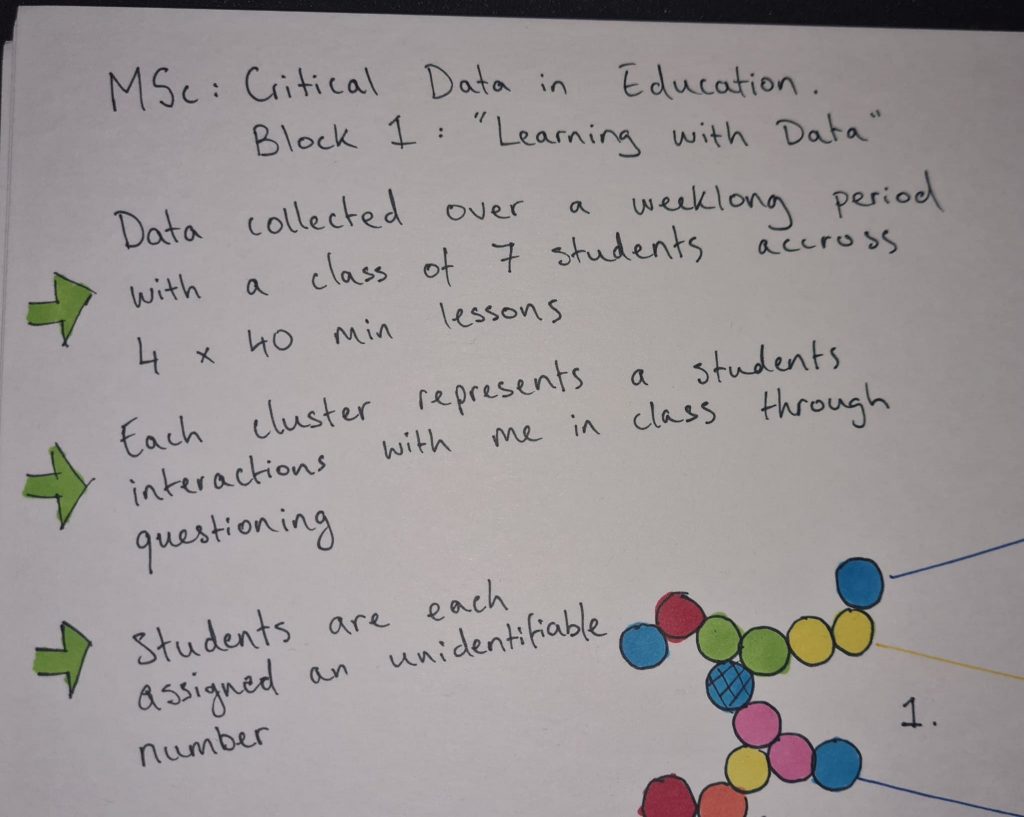
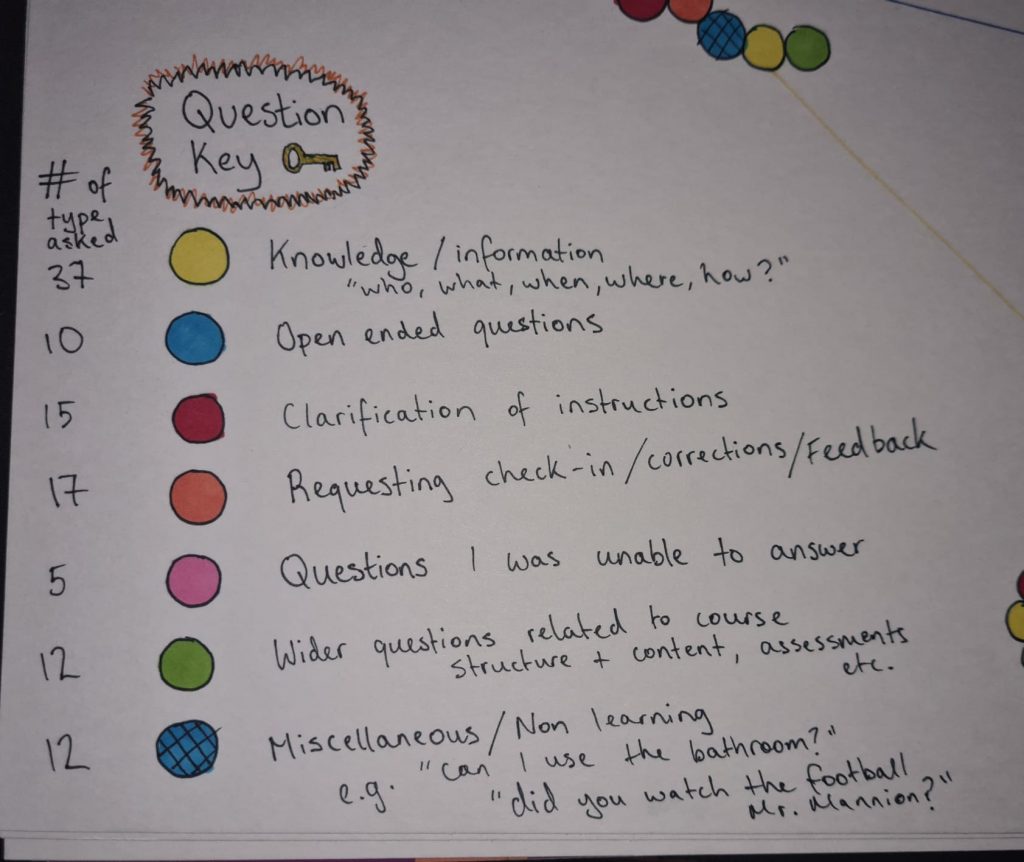
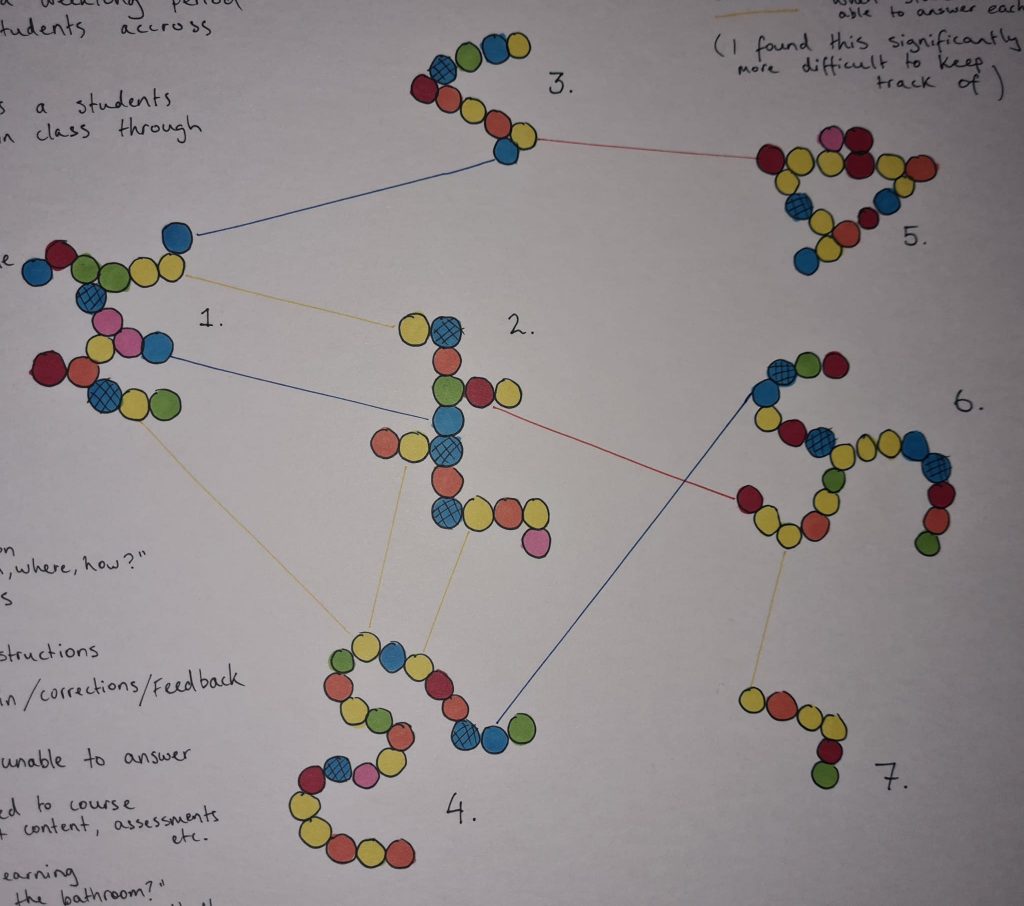
Each student is represented by a cluster of coloured dots with each colour describing the type of question they asked me. I found I needed to create more categories as the types of questions they posed became more varied. Early attempts were made to also keep track of when certain students were able to answer one another’s questions, and these are indicated by the lines connecting each student. I for sure missed a bunch of these moments throughout the week and in the course of the lessons and so this data is not as present in the visualization as the dots are.
I also included a key to make the data easier to analyse. Students were assigned a number to keep them anonymous, and one student (#7) only has a small cluster as they were out sick for the majority of the week.
Bibliography
Bayne S. (2015). Teacherbot: interventions in automated teaching. p. 463.
Bulger, M. 2016. Personalized Learning: The Conversations We’re Not Having. Data & Society working paper.
Friesen, N. 2019. “The technological imaginary in education, or: Myth and enlightenment in ‘Personalised Learning.” In M. Stocchetti (Ed.), The digital age and its discontents. University of Helsinki Press.
Levin, T, Long, R. 1981. Effective Instruction.
Knox, J, Williamson, B & Bayne, S 2019, ‘Machine behaviourism: Future visions of “learnification” and “datafication” across humans and digital technologies‘, Learning, Media and Technology, 45(1), pp. 1-15.
One response to “Block 1: Learning With Data”
Your engagement with the Block 1 readings comes through clearly in your reflective comments Mark and you’ve made useful connections with additional literature too.
I appreciated your wish to focus on “the human connection” in support of attempts by LA systems to “leverage rather than replace human contact” as it is often argued that these relationships lie at the heart of education. I’m interested in how LA systems might “augment” teachers and their activities and sometimes sceptical of assurances that automated systems aren’t intended to replace them.
Your comments about dialogue and the Socratic method reminded me of Meta’s recent advert Education in the metaverse where students watch Mark Anthony debate as if in 32 BCE. Meta works to blur the lines between on- and offline learning, proclaiming that “the metaverse may be virtual but the impact will be real”. These promotional narratives ignore that often “the medium is the message” and conceal the difficulties and decisions behind automated systems and their data representations which your reflections on your visualisation have successfully begun to surface.