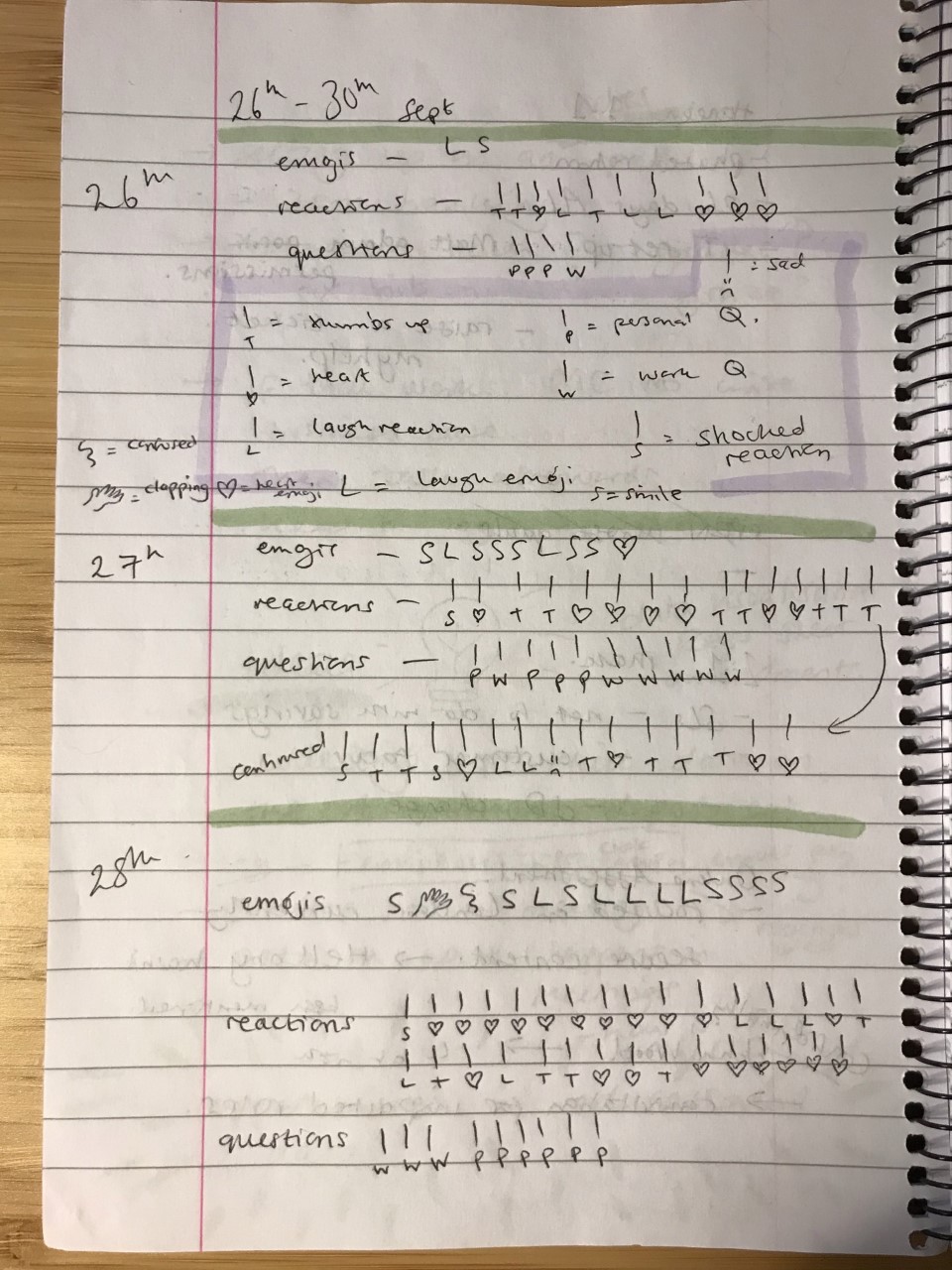
Learning with data – MS teams emoji visualisation
I reflected on the nature of working from home and the importance of communication tools as part of the socio-technical assemblage in my team’s interactions. My visualisation illustrates the interactions in the Microsoft Teams chat group by collecting data on emojis, reactions and questions to record a type of behavioural trace data without the context of the actual interaction akin to critiques of learning analytics data.
Selwyn (2020) discusses the promise of digital trace data to ‘observe more subtle difference in the ways that these learners organise their entire learning process’ in the same way, could recording and categorising chat functions as behavioural trace uncover subtleties of the team’s interactions to portray team culture and engagement?
The growing influence of data science in education tends towards specific governance, which ‘appear to work against notions of student autonomy and participation, seeking to intervene in educational conduct and shaping learner behaviour towards predefined aims’ (Knox et al, 2019). Similarly, the limited choice of expression that emojis allow mean that autonomy is narrowed, and my visualisation represents a simplified and datafied view of team communication. If the actual language used in chat messages or conversations were to be analysed, this would be much harder to complete, but would make clear the more complex and contextual factors.
Whilst emojis are simplified representation of a human reaction, the emulation of human practice could make the act of conversing via chat more satisfying: ‘behavioural economics relates to neuroscientific insights into dopamine and reward-processing in the brain’(Knox et al, 2019), just as is aimed to be done with learning technology to motivate activity.
As Bulger notes in relation to learning data; ‘measures reported by the systems are serving as proxies for, but not accurate representations of, attentional focus; however, this gap is not made explicit’ (Bulger, 2016, P16). This is highly relevant to how accurate my visualisation is in communicating the mood, engagement or culture of the team. The data should be taken as proxy, noting the lack of context and the fact that there are a finite number of emojis available, meaning individuals choose one that represents their sentiment most accurately; but can this be taken as authentic and how much meaning can be implied?
The ‘laser focus on numbers and performance metrics’ (Bulger, 2016, P13) associated with tracking and reporting on personalised learning systems is also relevant to workplace communication. The undertone of surveillance and performance measurement may mean individuals feel the need to represent being engaged through specific behaviour. No response does not mean no work is being done, nor should it signal employee performance or engagement.
My visualisation could be framed as a way to learn about team communication and culture, but ‘risks disregarding human factors and the socio-cultural contexts in which the data is generated’ (Perrotta 2013; Gašević, Dawson, and Siemens 2015). (Tsai et al, 2020) in the same way student data from digital learning environments does.
References:
Bulger, M. 2016. Personalized Learning: The Conversations We’re Not Having. Data & Society working paper. Available: https://datasociety.net/pubs/ecl/PersonalizedLearning_primer_2016.pdf
Bulger, M. 2016. Personalized Learning: The Conversation We Need. Talk given by Monica Bulger, covering many of the issues discussed in the above paper.
Friesen, N. 2019. “The technological imaginary in education, or: Myth and enlightenment in ‘Personalised Learning.” In M. Stocchetti (Ed.), The digital age and its discontents. University of Helsinki Press.
Knox, J, Williamson, B & Bayne, S 2019, ‘Machine behaviourism: Future visions of “learnification” and “datafication” across humans and digital technologies‘, Learning, Media and Technology, 45(1), pp. 1-15.
Selwyn, N & Gašević, D, 2020 The datafication of higher education: discussing the promises and problems, Teaching in Higher Education, 25:4, 527-540, DOI: 10.1080/13562517.2019.1689388
Tsai, Y-S. Perrotta, C. & Gašević, D. 2020. Empowering learners with personalised learning approaches? Agency, equity and transparency in the context of learning analytics, Assessment & Evaluation in Higher Education, 45:4, 554-567, DOI: 10.1080/02602938.2019.1676396
