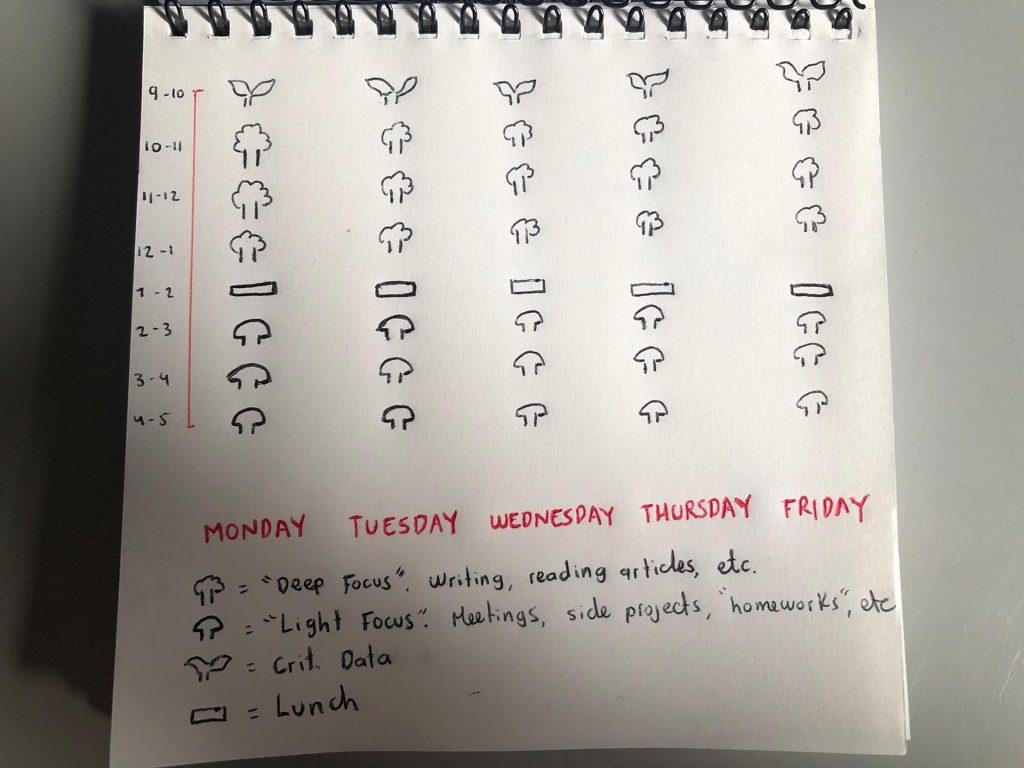
First Visualization. “Before”
I share the “before” version of my first visualization. Based on the readings of this block, I had the idea to first share the template of the envisioned visualization, and then contrast it with how the actual data were (was?) gathered afterward.
The idea came mainly from the article “Machine behaviorism”. I found its reading challenging, compelling, and conceptually rich. One of my main takeaways is that datafication updates but also challenges the “learnified” idea proposed by Biesta of the student as a rational, homo-economicus, neo-liberal consumer. Rather, datafication evokes again a central power, but this time the power is held by the algorithm. It is also interesting that this new conception of learning (and learners) is supported by behavioral ideas of the student as someone who does not always act out of his/her best interest, and in that sense is always in need of a good “nudge” to get back on track.
Informed by these ideas of a new form of anticipatory or predictive form of governance that acts upon learners, I propose my first visualization. The “before” visualization acts as a normative guide for how my week as a learner should look like. As the initial quote of “Dear Data” says: My experience is what I agree to attend to. This visualization then limits or, at least, heavily influences the range of phenomena I will (or wish to/ought to) attend to.
The visualization represents my intended week as a student. Instead of me deciding every day what I will do at every moment of the day, or how I want to accommodate my schedule, I rather set a fixed schedule. It can be argued that this, in a way, assumes a tendency to deviate from what is better for me in the long run (one of the main assumptions of behavioral psychology). Lastly, and as said before, this visualization acts as a model to which I must respond. This resonates with one quote from the article that inspired this experiment: “learners are assumed to respond directly to what the dashboard reveals (and now even anticipates), rather than evoking some kind of consumerist desire”.
Let’s see how the experiment goes. I will share the “after” visualization on Friday or Saturday of this week.